Real Estate law | CPA | Business Adviser
Home
Data Centers
Insights
Our Mission
NVWM REIT
PB102 FUND
INSPIR3 Architecture
Palm Housing Foundation
NVCG
Real Estate Finance
  • NVWM Down Payment
  • Conventional Loan
  • FHA Loan
  • VA Loan
  • JUMBO Loan
  • Reverse Mortgage
  • HELOC
  • DSCR LOAN
  • Bank Statement LOAN
  • NON-US CITIZEN LOAN
  • Hard Money Loan
Investors
Careers
Connect
Privacy Policy
Real Estate law | CPA | Business Adviser
Home
Data Centers
Insights
Our Mission
NVWM REIT
PB102 FUND
INSPIR3 Architecture
Palm Housing Foundation
NVCG
Real Estate Finance
  • NVWM Down Payment
  • Conventional Loan
  • FHA Loan
  • VA Loan
  • JUMBO Loan
  • Reverse Mortgage
  • HELOC
  • DSCR LOAN
  • Bank Statement LOAN
  • NON-US CITIZEN LOAN
  • Hard Money Loan
Investors
Careers
Connect
Privacy Policy
More
  • Home
  • Data Centers
  • Insights
  • Our Mission
  • NVWM REIT
  • PB102 FUND
  • INSPIR3 Architecture
  • Palm Housing Foundation
  • NVCG
  • Real Estate Finance
    • NVWM Down Payment
    • Conventional Loan
    • FHA Loan
    • VA Loan
    • JUMBO Loan
    • Reverse Mortgage
    • HELOC
    • DSCR LOAN
    • Bank Statement LOAN
    • NON-US CITIZEN LOAN
    • Hard Money Loan
  • Investors
  • Careers
  • Connect
  • Privacy Policy
  • Sign In
  • Create Account

  • My Account
  • Signed in as:

  • filler@godaddy.com


  • My Account
  • Sign out

Signed in as:

filler@godaddy.com

  • Home
  • Data Centers
  • Insights
  • Our Mission
  • NVWM REIT
  • PB102 FUND
  • INSPIR3 Architecture
  • Palm Housing Foundation
  • NVCG
  • Real Estate Finance
    • NVWM Down Payment
    • Conventional Loan
    • FHA Loan
    • VA Loan
    • JUMBO Loan
    • Reverse Mortgage
    • HELOC
    • DSCR LOAN
    • Bank Statement LOAN
    • NON-US CITIZEN LOAN
    • Hard Money Loan
  • Investors
  • Careers
  • Connect
  • Privacy Policy

Account

  • My Account
  • Sign out

  • Sign In
  • My Account

DATA CENTERS & ENERGY EFFICIENCY

Data centers are mission-critical real estate: highly engineered facilities housing servers, storage, and networking equipment powering cloud computing, enterprise applications, streaming, digital commerce, and AI workloads.  Computer servers are defined as computers that provide services and manages networked resources for client devices, such as desktop computers, notebook computers, thin clients, wireless devices, PDAs, IP telephone, other computer servers, and other networked devices.


Energy is typically the largest operating cost in data centers and the defining constraint on scalability. Efficiency is therefore both a margin driver and a competitive advantage, influencing leasing velocity, tenant retention, and long-term viability;  a "Sense of Congress": It is in the best interest of the United States for purchasers of computer servers to give high priority to energy efficiency as a factor in determining best value and performance for purchases of computer servers.


Computer servers must meet multiple criteria. Among other things, power supplies used in computer servers must meet minimum efficiency requirements. Computer servers must not exceed specified idle power levels. There are additional idle power allowances for extra components such as additional power supplies, additional hard drives, additional memories, and additional I/O devices.


Guiding Principles for Data Centers Energy Efficiency Metrics: 


(i)  Power Usage Effectiveness (PUE) using source energy consumption is the preferred energy efficiency metric for data centers. PUE is a measurement of the total energy of the data center divided by the IT energy consumption. 


(ii) When calculating PUE, IT energy consumption should, at a minimum, be measured at the output of the uninterruptible power supply (UPS). However, the industry should progressively improve measurement capabilities over time so that measurement of IT energy consumption directly at the IT load (i.e. servers) becomes the common practice. 


(iii) For a dedicated data center, the total energy in the PUE equation will include all energy sources at the point of utility handoff to the data center owner or operator. For a data center in a mixed‐use building, the total energy will be all energy required to operate the data center, similar to a dedicated data center, and should include IT energy, cooling, lighting, and support infrastructure for the data center operations.
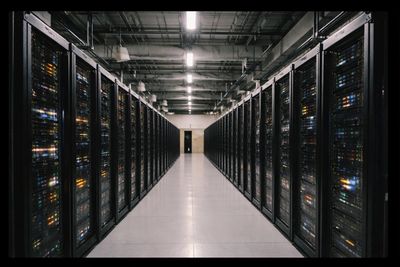

COMPETITIVE advantage of enhanced data center efficiency

  1. Financial Savings: Enhanced data center efficiency reduces energy waste and optimizes performance, resulting in significant cost savings.
  2. Energy Savings:Enhancing energy efficiency in data centers reduces energy waste, allowing reclaimed resources to be redirected to other building operations.
  3. Improved Security: Modernized data center equipment minimizes the risk of cyber threats and reduces the potential for losses caused by technical failures.
  4. System Performance: High-efficiency data center equipment and systems are less susceptible to overheating and failures, thereby lowering maintenance requirements.

© 2026, NVWM, LLC. ALL RIGHTS RESERVED.

  • Data Centers
  • Insights
  • Our Mission
  • NVWM REIT
  • PB102 FUND
  • Palm Housing Foundation
  • NVCG
  • Investors
  • Careers

This website uses cookies.

We use cookies to analyze website traffic and optimize your website experience. By accepting our use of cookies, your data will be aggregated with all other user data.

Accept